
WRITTEN BY Cedric K. H. Goh, CGD ART STUDIO
Edited Dec 19th, 2025. © All Images Copyright 2024 by CGD ART STUDIO, Unless specified otherwise .
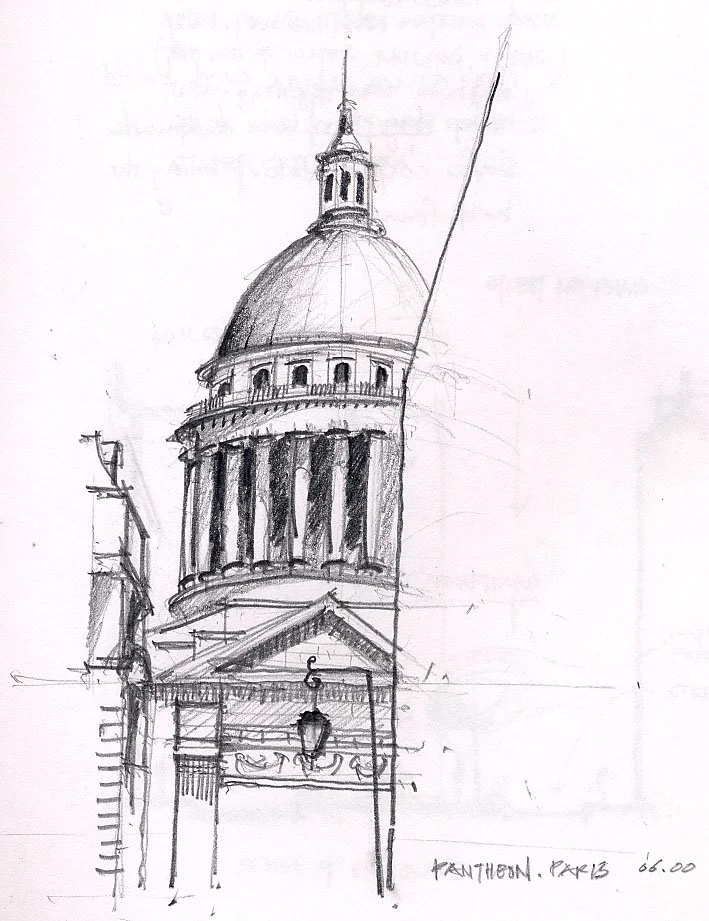
Image : Pantheon, Paris
Content
The art and science of making spaces memorable
…………………………………………………………………………………………………………………………………
The Profession of Crafting Spaces
Urban Spaces
Types of Open Spaces
Defining An Urban Public Space
Urban Place-making
The Architecture of Place
1. The Profession of Crafting Spaces
— Between light and darkness hides the perfect space.
Architecture is not about the architect; neither is interior design about the designer. Whether it is architecture or the interiors, we are still dealing with space. It is essentially about the place and the inhabitants. Architecture reflects the founding of a culture and celebrates the achievements of a society. It is in essence the markings of our existence. In the context of design, architecture begin as the craft of creating boundaries that defines our usable living spaces. While interior design is the art of making those living spaces sparkle. Well-conceived interiors have the ability to impart a strong sense of an authentic place while we enter the space. That is the essence of the ‘personality’ of a space – defined here as PLACE.
The decoration and ‘the look’ of the interior spaces have no relevance to how well they are designed. Those are merely unnecessary distractions. Although it is important to note that memorabilia and meaningful fixtures and furnishings are important elements in lending a space its character and personality. Well-conceived spaces can have the capacity to transform us with its beauty. Not just the exclusiveness of materials, but also the beauty of materials coming together, and the simplicity in carefully crafted functional spaces with the existence of every detail to serve a particular design or functional purpose. The result is a timeless interior that truly speaks to us as users of the space. Profoundly inspiring spaces do not shout at us with its over-indulgent design elements, but rather communicate with us through its self-assured, quiet yet subtle presence. It is the harmony of the collective elements that gives us the feeling of a soulful place.
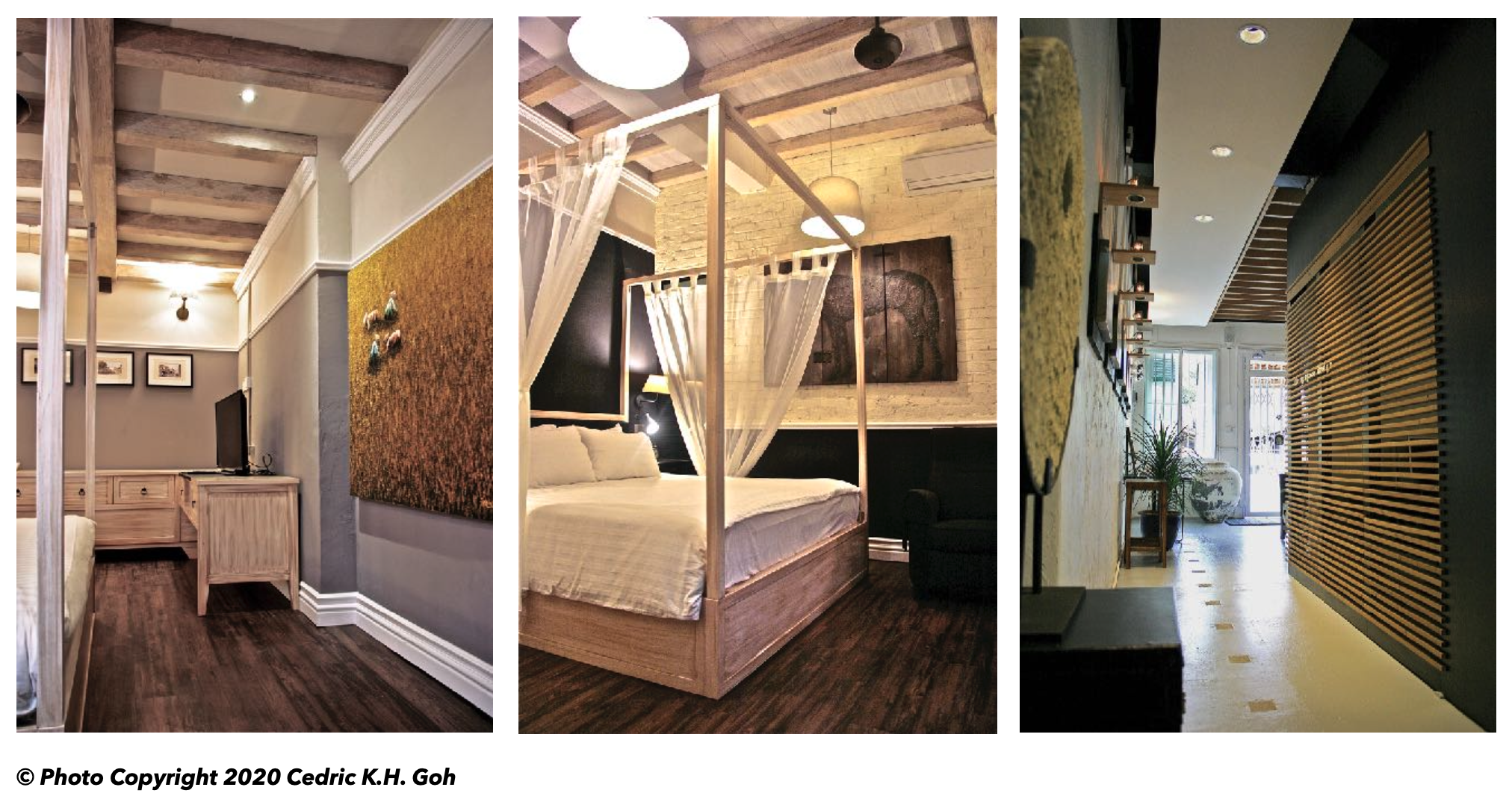
It is important to study and express those ideas about creating PLACES. Each individual project may take on a different approach in addressing the notion of place, though each must discover its own distinct sense of identity. They do not necessarily need to adhere faithfully to specific design traditions or rules resulting in specific style or idea of space, but rather idiosyncratic in its own way of expressing a distinctly eclectic design language.
Inspiring places are created to be distinctive, creating a visual marking in our understanding of our built environment. We may not remember the coordinates or building numbers of places we have visited, but we will remember the soul and inspiring experiences of a particular place.
2. Urban Spaces
Cities like Paris, or any other densely built urban environment, can be seen as having two main types of spaces - 1. Built spaces 2. Open spaces
It is common for most people to see and appreciate a city and its architecture but unaware of the role of public open spaces. A big part of city is made of open spaces, and it is through these open spaces which we see and experience a city, its life and its buildings. The reason for studying the open space is that dense urban architecture is very much about the walls (facade). Ultimately, the wall is there to seperate the inside from the outside. The inside then becomes a “SITUATED SPACE” while the outside maintains its function as “MOBILE SPACE”. Mobile space is coined here as a reference to an interstitial space allowing movement, activities and human experiential events to take place. These places can be a pocket parks, boulevards and religious or public building grounds.
Buildings are important, but what makes a place unique is also its environment, its unique context that gives the building a PLACE.
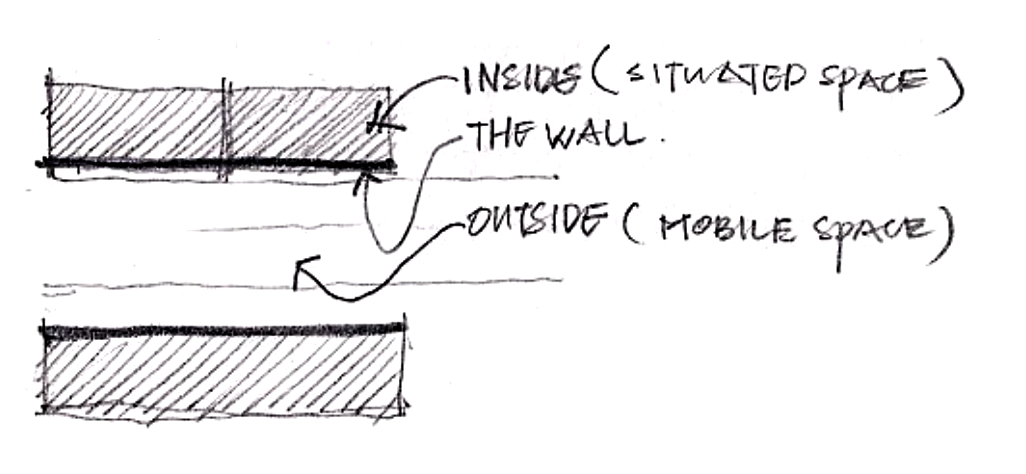
A diagrammatic plan sketch of street spaces
SITUATED SPACE - Architecture of Buildings
FLUID (MOBILE) SPACE - Architecture of Place
3. Types of Open Spaces
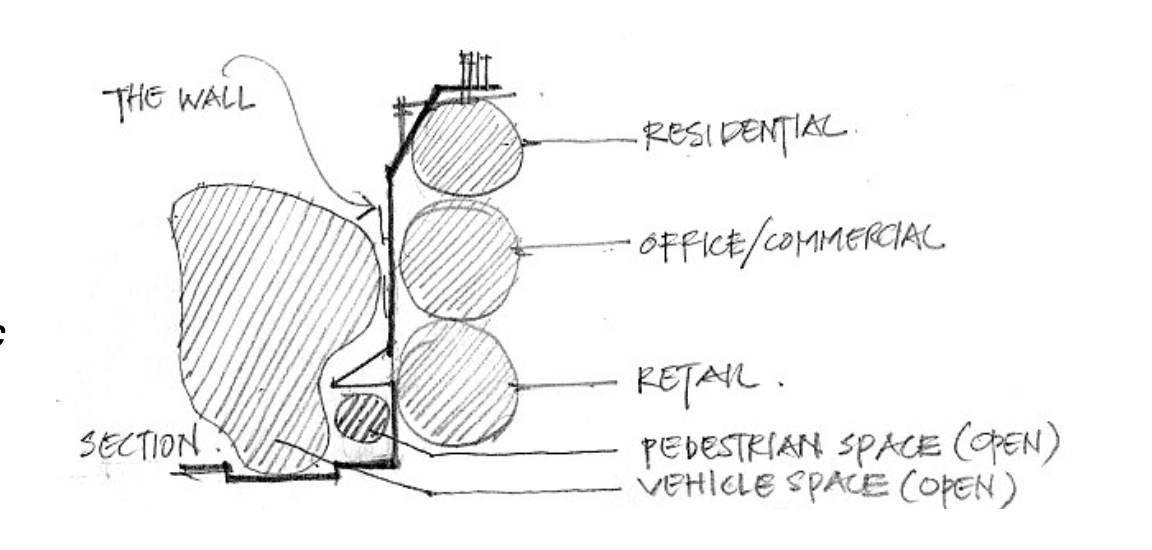
Boulevards / Streets
Pocket Parks / Large public space
Small public “courtyards” / Alleys + Walkways
Small interior courtyards
Typical layering of programmatic spaces to a certain extent controls the architecture of the city. The horizontal layering imposes uniformity across the city. Seeing a dense urban city from bird’s eyes view is very different from ground level. From the ground, we see the clarity in its adherence to city guidelines. While from the top, we see the idiosyncrasies in every street corner. To a certain degree, it even has an eclectic and chaotic feel.
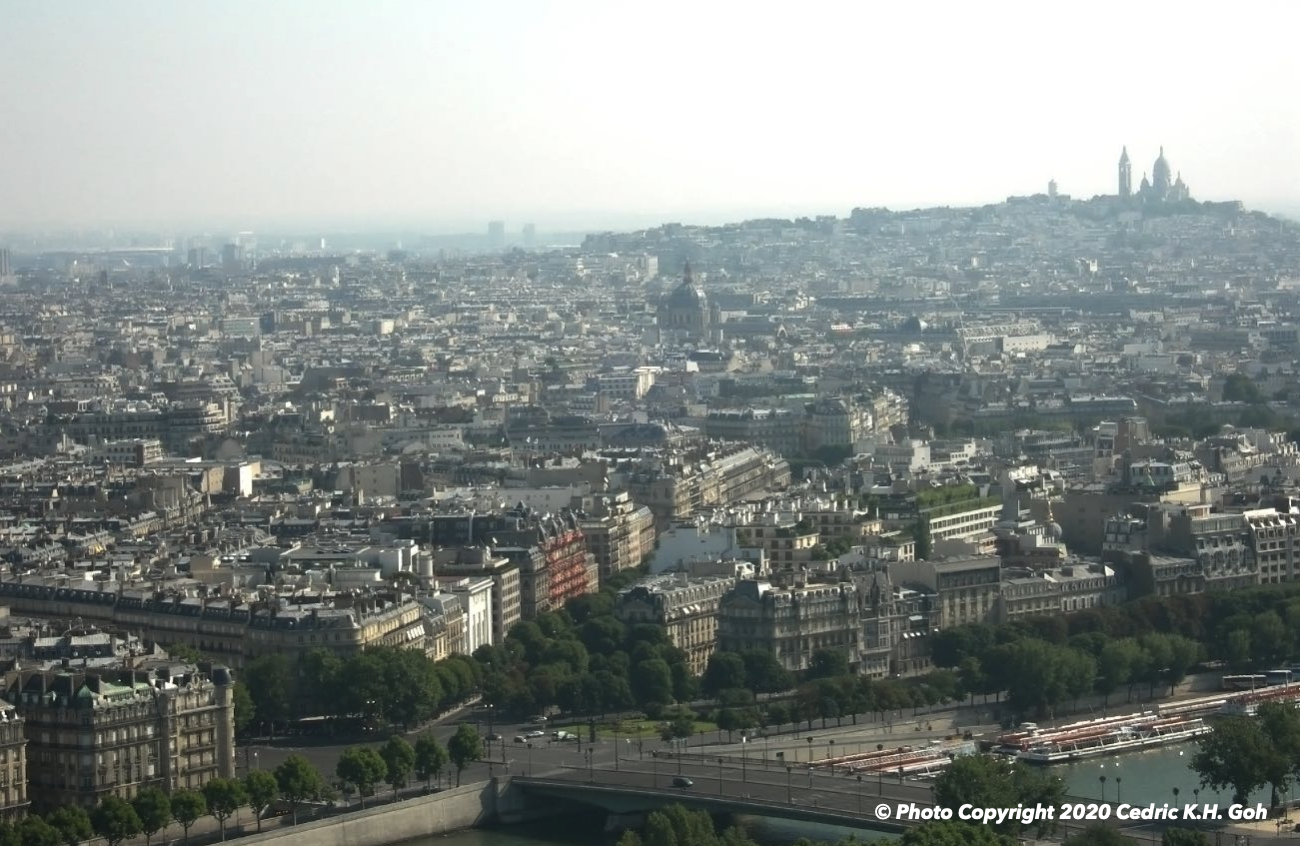
Image : From a bird’s eye view of the city of Paris, Basilique du Sacré-Cœur de Montmartre commands a sweeping view above the hill, marking an important focal point amidst the dense urban fabric of the city.
4. Defining An Urban Public Space
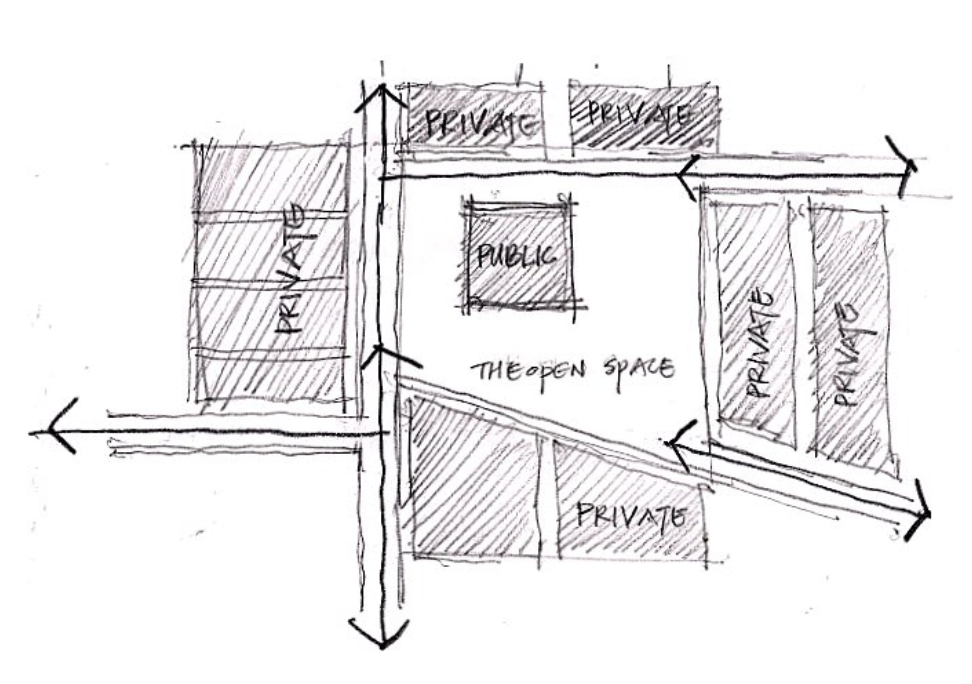
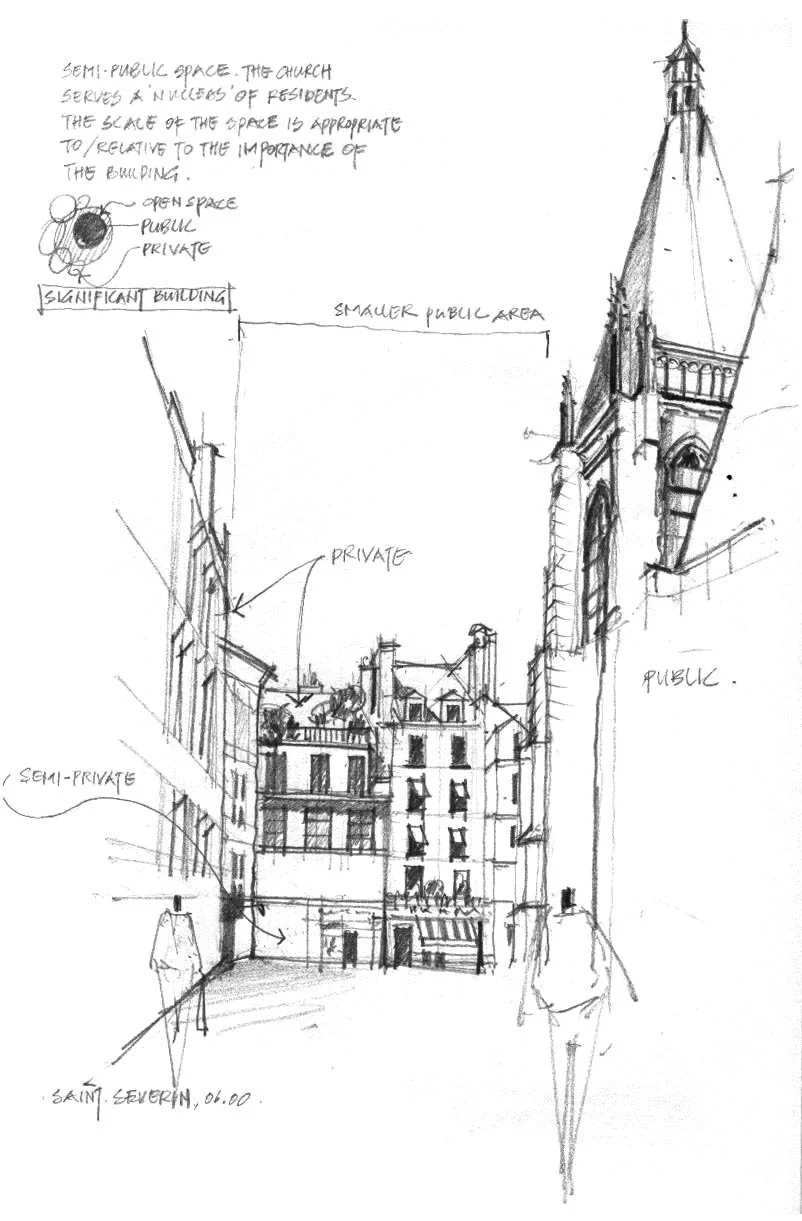
I prefer to make reference to urban public space as, “Architecture of the open space”. Though we are building walls to create enclosed spaces, fundamentally we are equally addressing the outside space as much as the inside. It is fascinating when we observe architecture in a completely different way. When we are in a building, we subject ourselves to the experience of being in an enclosed space, defined by its boundary articulation, surface treatment, lighting, fenestration and furnishings. Within that enclosed space, the spatial experience is of the inside. While being outside, we are in fact experiencing the architecture of the open space. Therefore, the qualities of that architectural experience is relative to the location where we stand. Likewise, the qualities of a public open space is subjected to its contextual qualities or architecture of the outside - whether buildings, gardens or a forest.
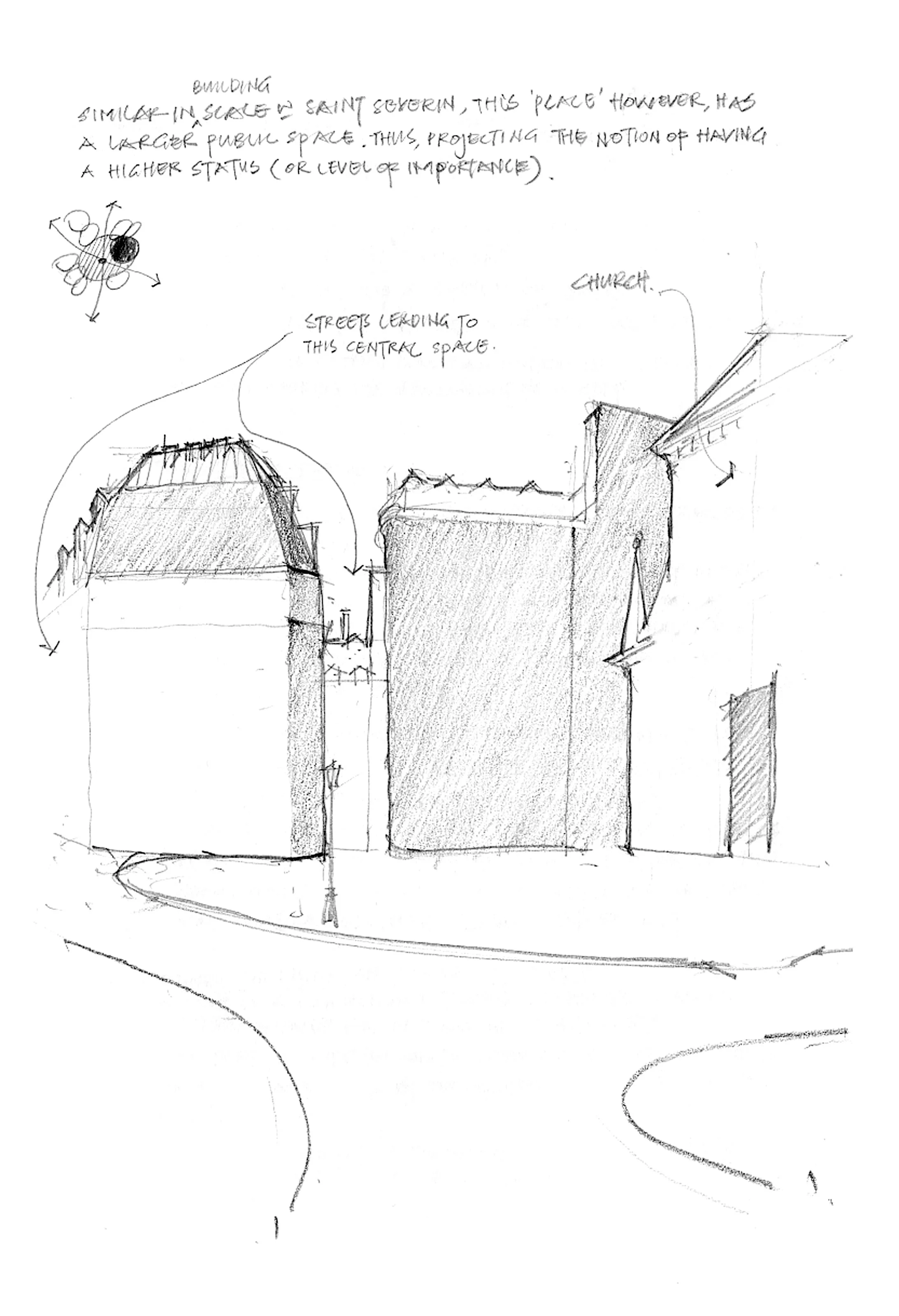
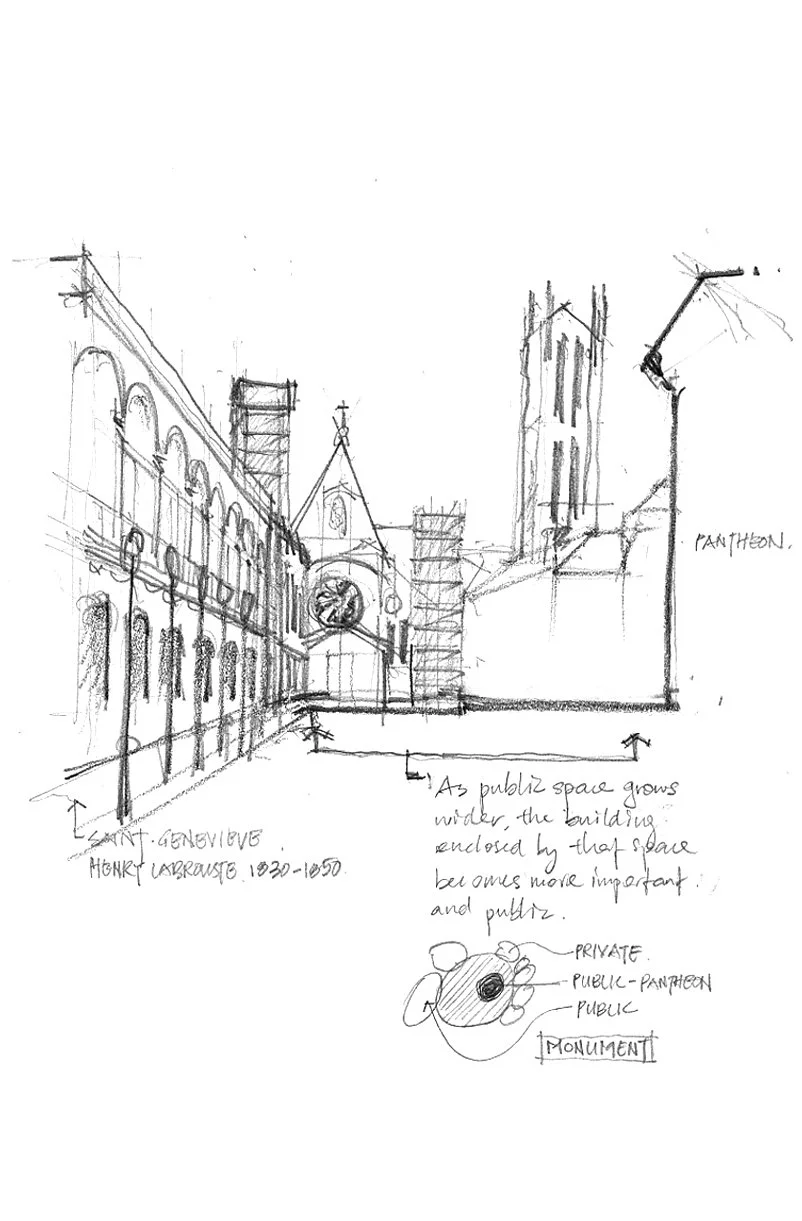
Similar to interior spaces, the scale of the outside spaces suggests the importance, character and “experiential” qualities of that space. The context of a building is relative to the ground it sits and to the surroundings which help to derive its character. As the street / open space around a building becomes wider, it begins to suggest its greater public presence. As the open space shrinks, we perceive the building as having only “local” presence, meaning making reference only to a particular locality or neighborhood.
The making of a public building is therefore not only its scale. Its public image can be derived from the scale of its surrounding open space, private spaces and buildings around it.
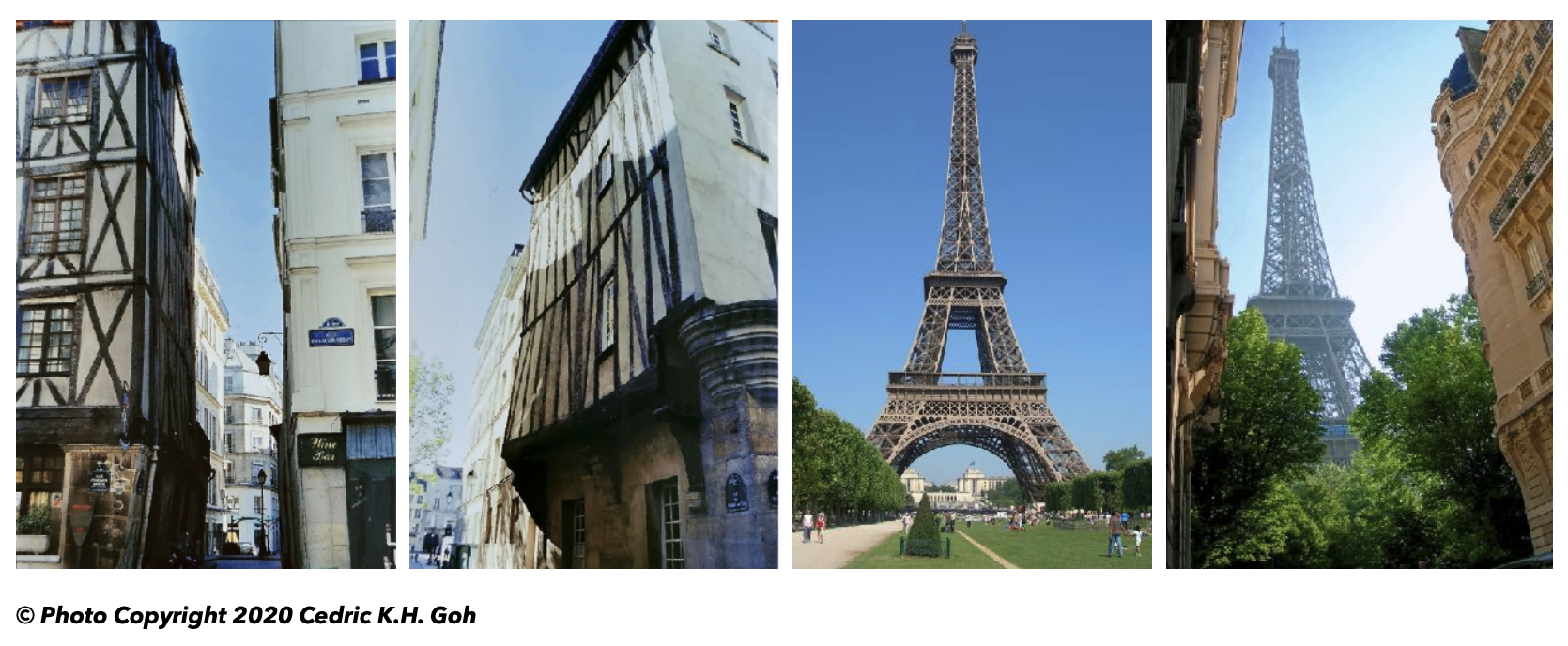
Image : The above photos show how public structure like Eiffel Tower scale its public space in response to its public significance. While in contrast, urban archtiecture defines a complex heirarchy of public spaces with its varying scale of public spaces.
5. Urban Place-making
Cities are made of buildings, but hardly anyone notice that it is the public spaces, the landmarks, obelisks, boulevards and charming streets that weave the stories of buildings together. Those immaculately aligned trees along the streets provide boundaries and a sense of calm and serenity, while we traverse the public sidewalks and through narrow streets finding our way around endless rows of buildings.
1. Streets : Connecting the dots
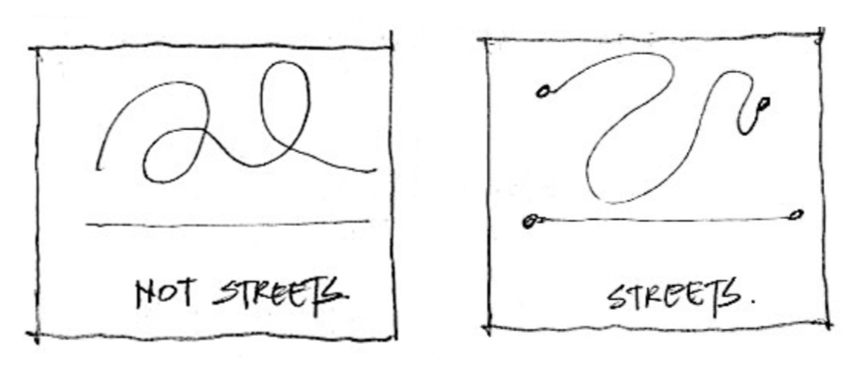
A street needs to have a destination. Without a destination, a street is no different from an open space. For instance, any line drawn on a piece of paper can be called a street. But if it is not leading to anywhere, it has no meaning for its existence as it lacks a direction. It is like someone running around a football field and leaving a trail of footprints. They are all “pathways” but are they streets? Simply because the “trails” lead to nowhere. Therefore, a city begins to grow not by the number of streets we add, but by the number of places we want to grow. Streets are about destinations, without it, streets would not exist in the first place.
A street is not formed by rows of building either, but rather it exists with the sole reason to reach a destination. Modern urban planning efforts of creating “landscape plazas” has replaced the traditional form of creating recognizable “places”. Landscape plazas are generally vast open spaces of trees, plants, hardscape and some form of artwork and features to accommodate human activities. But what it usually lacks is a relationship to urban planning and its context of buildings.
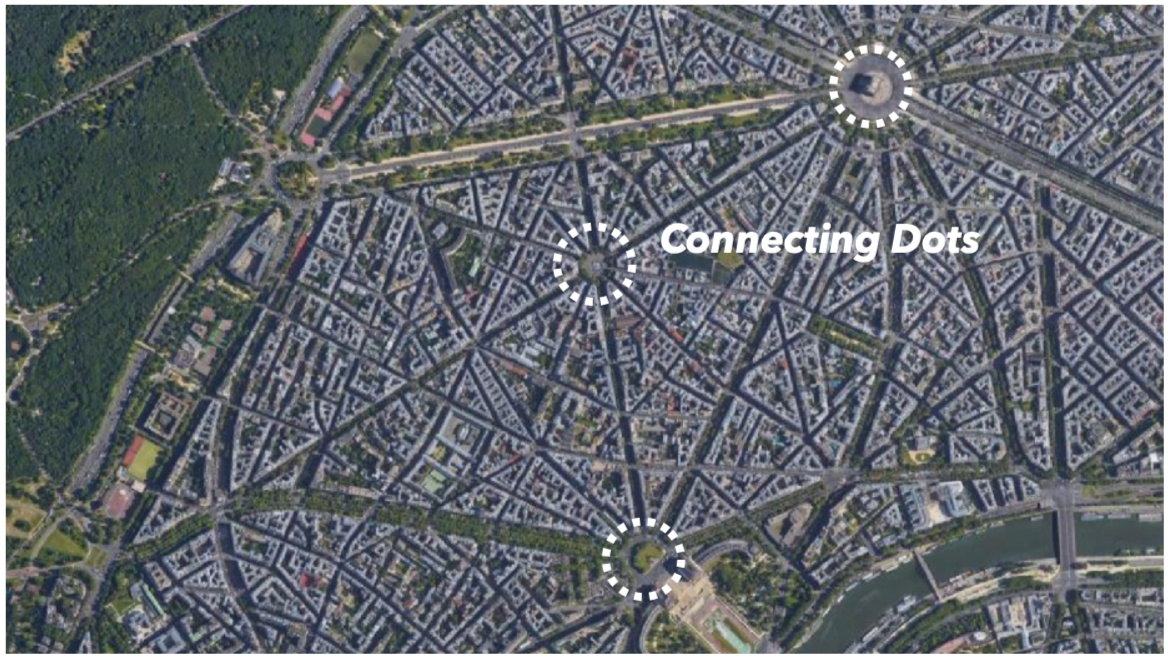
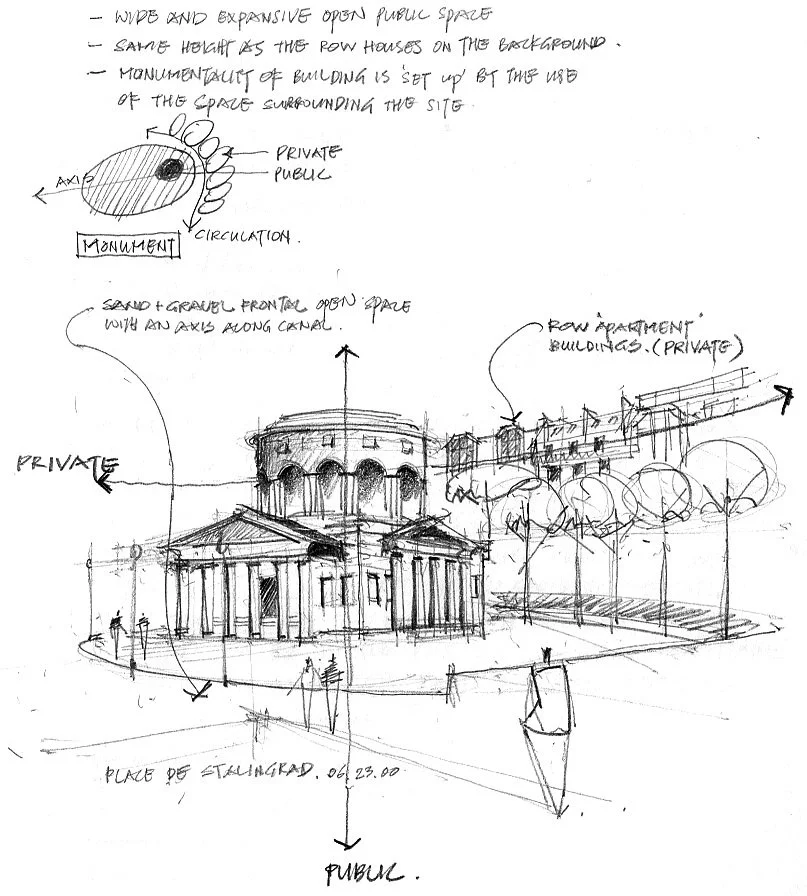
The above image shows the typical urban planning of Paris. It clearly indicates the intentional angulated streets punctuated by landmarks serving as connecting ‘points’ for all major streets.
2 Landmarks : Points on a surface
Landmarks are points within a complex web of roads and streets. Obelisks, Statues on roundabout, Monuments are some examples of landmarks. They are all points on a map of streets. They serve to locate a place. These points sets up a system of places which then dictates the formation of the urban park. As opposed to laying down an entire grid, it laid down points, perhaps marking the beginning of a place.
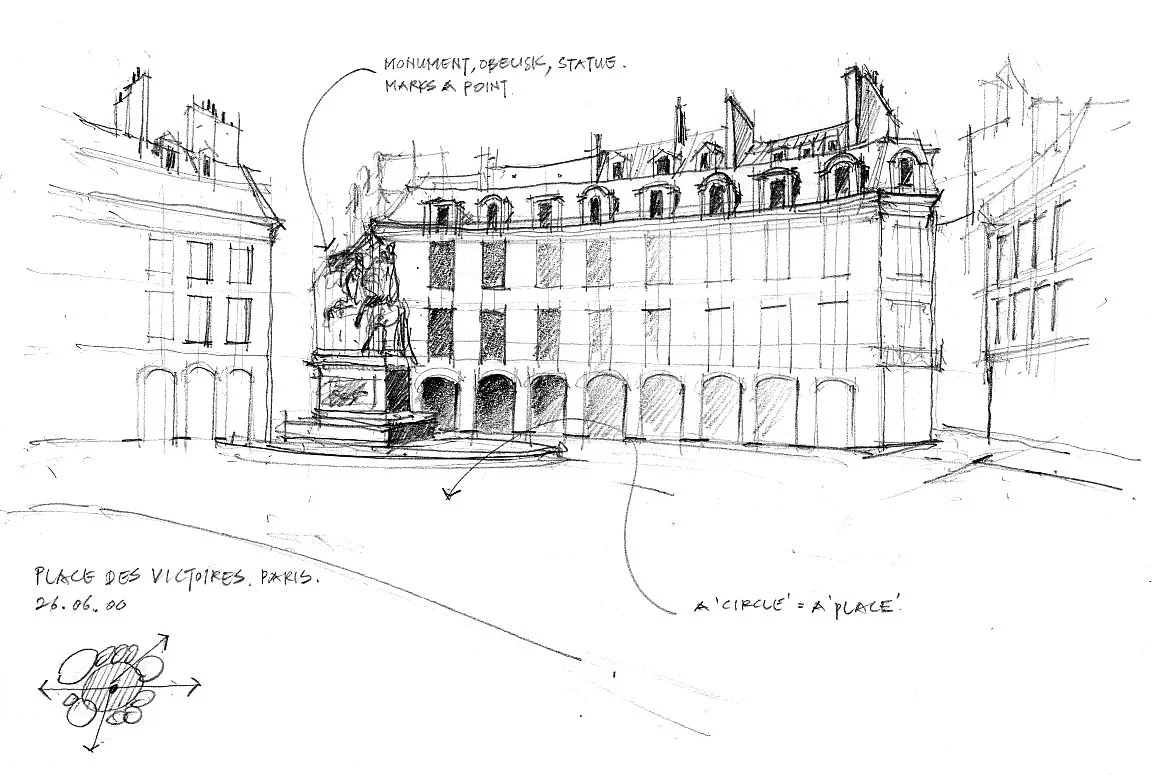
The above is a sketch of Place des Victoires. It is a classic example of fluid space, allowing traffic to move through or pedestrian traffic to pause, yet having its undeniably unique building facades cohesively participating in creating a sense of place.
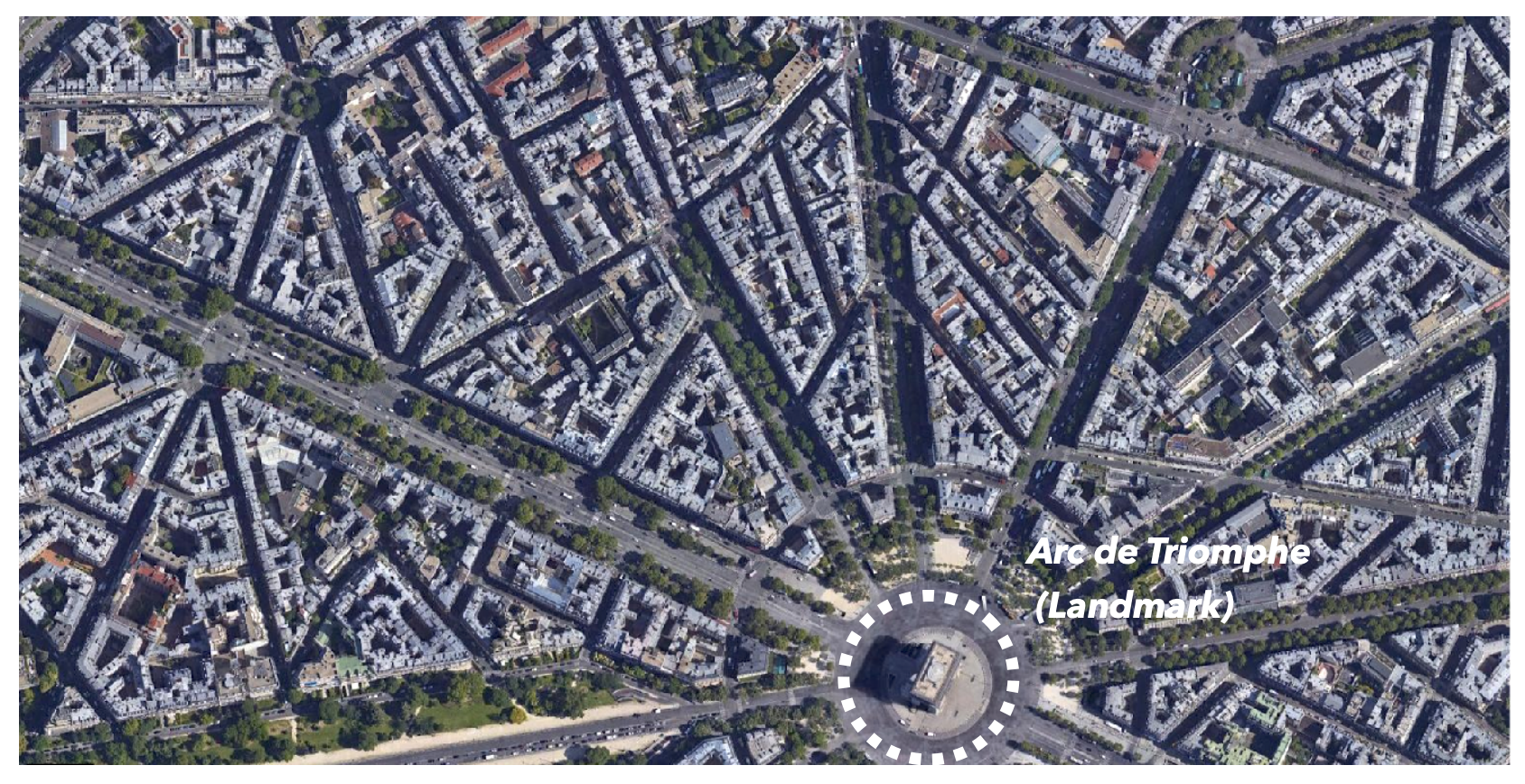
The above satellite image shows the qualities of Place des Victoires - a circle on a plane, together with a landmark it connects secondary thoroughfares, linking to adjacent main traffic arteries.
3 Place : A circle on a plane
Putting a circle on a plane is not about the exact coordinates or imposition of geometry in city planning. It is more about a visual way in mapping the city. People navigate themselves through old cities by recognising and visually mapping these places in order to establish that sense of place. As opposed to an old city, the new urban city is about conformity, boundaries and systems. The new city has lost its charm of having “places”. It has no visual or physical representation of the “coordinates” of a city. It has become an abstract rational grid extruded into reality.
Old cities do very well in creating places. Some examples of places - Place des Victoires, Place des Vosges, Place Charles de Gaulle, etc. These places are defined by their uniquely individual place-making qualities. They seem to understand how connected streets, landmarks and public places are like coordinates creating a complex web of individual places with distinctive identities.
6. The Architecture Of Place
As collective design professionals, architects, engineers, urban planners, landscape architects and interior designers all play an important role in our built environment. However, there is not one profession that specializes in the architecture of place. We design buildings, and so we engage in a discourse about buildings, but what makes a place memorable? Who then is the real architect of a place? When was the last time “a place” gave you memories and profound experiences that stayed deep within you? Do we all remember the phrase “a sense of place”? What are the elements that define a sense a place?
One of my most memorable place is Mont Saint-Michel, Normandy, France. It wasn't just a Medieval abbey on an island but a place, embraced by tides, isolated yet full of character, charm, history, and most importantly, a sense of place. It is perhaps not only one of the most unique project to be built, but a timeless piece of architectural history being gifted a place.
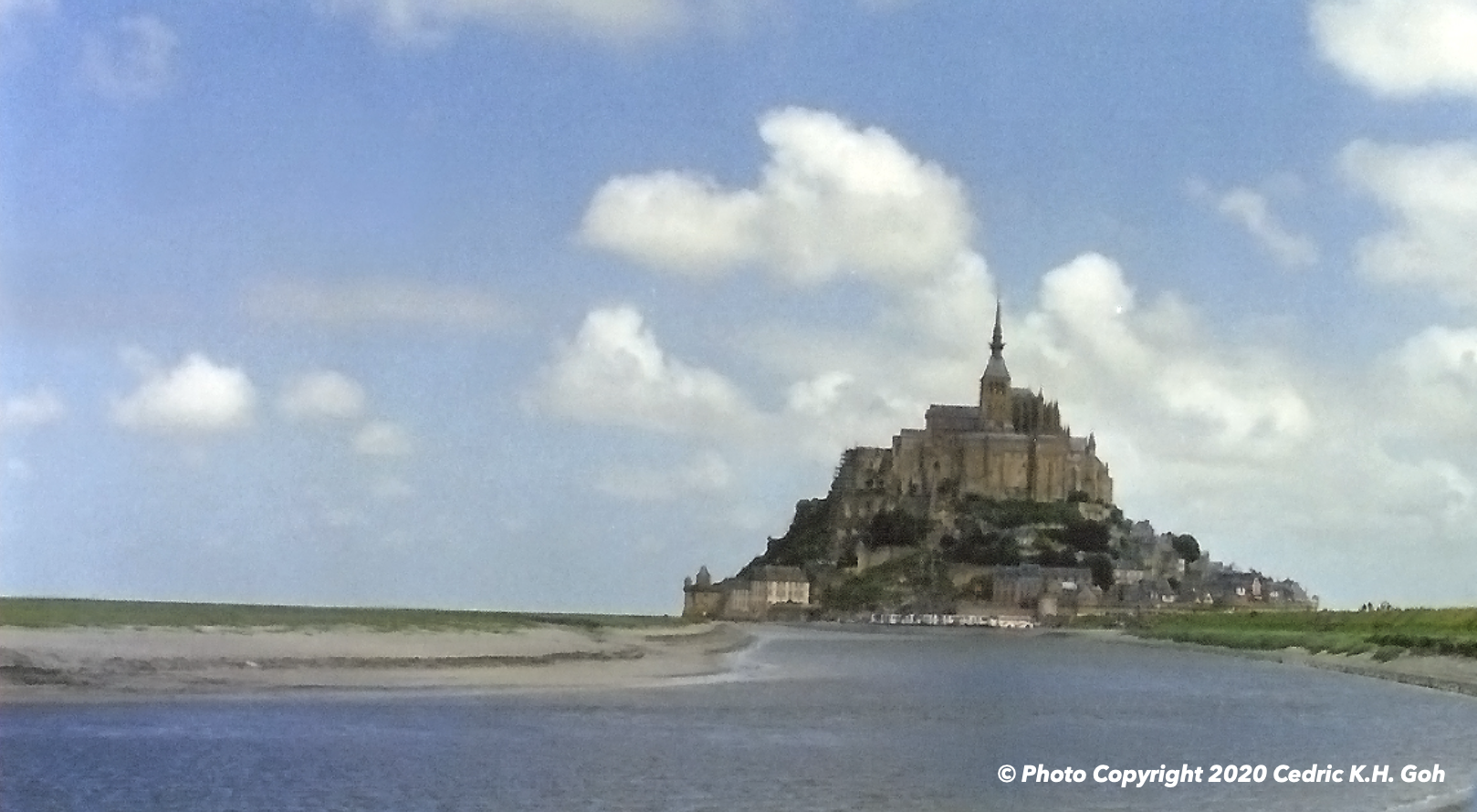
Image : Mont St. Michel, France
Another timeless example is white-washed buildings of Greek islands in the mediterranean sea. Buildings are hardly unique architecturally speaking. The entire island village spotted uniformly in white, completely lacking in random individual charm. But the uniformity collectively conveys the qualities as well as the notion of place-making. The beauty of it is the elements that define the character of the place. From the time-tested construction methods, the pretty cobbled streets and stunning blue seascape to the seemingly endless breeze brushing against our cheeks, the experience is no doubt uniquely memorable.
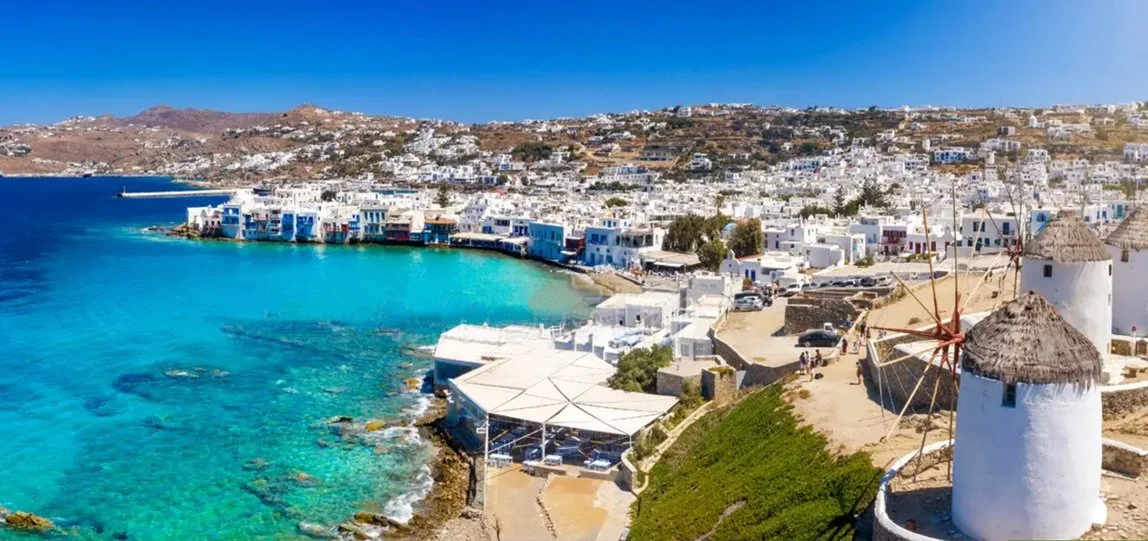
Image : Mykonos Island, Greece
How do we apply such timeless place-making design thinking to each unique project we face on a daily basis? Do we then find solace in hiding behind our reputable professional expertise or do we seek to engage those profound ideas and be enlightened by that revelation?